Behind the Mic: Lowell’s Student Broadcasters Powering Red Arrow Athletics
Reporter - Justin Scott
Students Interviewed - Kyle Stauffer, Eli Wilcox, Tray Coulier
During athletic events at LHS, all eyes are on the action. If you’re at home, though, you can thank Lowell Radio for some of the most consistent sportscasting and video coverage, allowing you to watch from the comfort of your home. Lowell Radio has built a proud tradition through the hard work of station manager Al Eckman and his student sportscasters.
On fall Friday nights at Bob Perry Field, during winter basketball games, and on spring afternoons at the baseball field, those guys are hard at work bringing you the game.
Just this year they’ve hit 39 events including every varsity football game and 19 boys and girls basketball games.
These students, along with Eckman, prepare, set up equipment, and handle the call themselves. Setting up the equipment alone is not easy, especially for road games. It is often a lengthy process that requires transportation, organization, and some heavy lifting.
Once everything is in place, Al and his team, comprised of students like Kyle, Tray, and Eli, get to work.
The students manage audio levels, troubleshoot technical issues, coordinate play-by-play and color commentary, and adjust on the fly when something does not go according to plan.
Senior Kyle Stauffer has been part of the program for six years. He has seen it grow from a learning opportunity into a consistent way to serve the Lowell community. Stauffer is looking to attend the University of South Carolina to pursue sports broadcasting, a career Eckman believes he can excel in. This year, Stauffer even added in halftime interviews with players to fill in time that used to be filled with some of the thousands of songs in the Lowell Radio library.
During his visit to USC’s broadcast journalism program, he saw firsthand what a college-level operation looks like. Seniors there spend an entire semester producing daily news segments, rotating through roles and working long hours inside the studio. It is a structure that mirrors much of what he has already experienced inside the booth at Lowell.
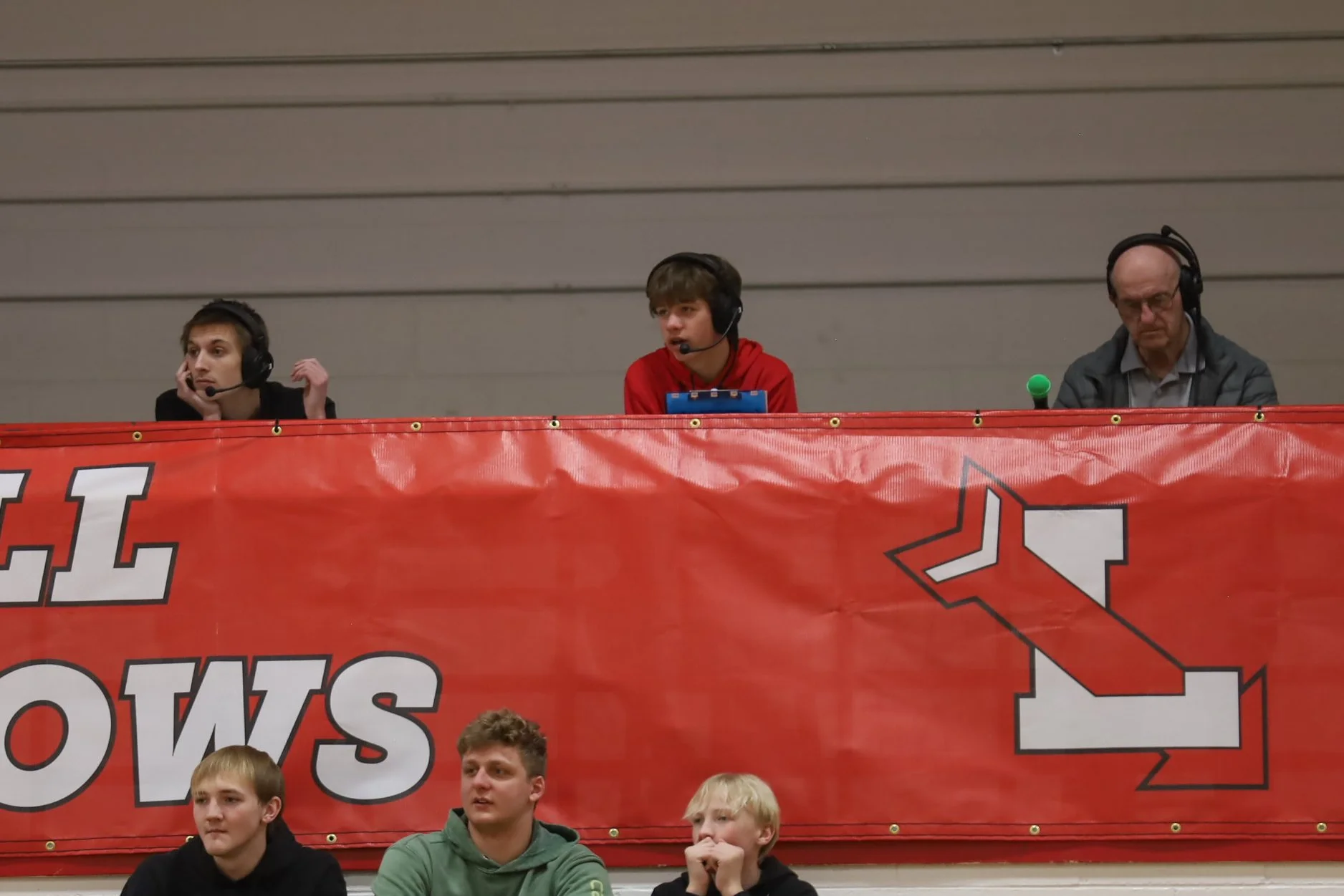
Kyle Stauffer, Tray Coulier, and Al Eckman (left to right) calling a basketball game in 2025.
For Stauffer, the foundation was built at LHS. Calling games for your own school presents a unique challenge. The excitement of a big fourth-down stop or a late three-pointer is real. The job, though, is to capture the moment clearly so listeners and viewers understand what is happening.
“You want to show emotion during big moments,” Stauffer said. “But you also have to stay controlled.”
Junior Tray Coulier said the biggest change for him over the years has been learning how to manage those big moments. One example, unanimously agreed upon during the podcast, was Lowell’s regional championship win over Zeeland West in football. Lowell survived a late drive by the Dux to advance to its first semifinal since 2016.
“At first it’s easy to let the excitement take over,” Coulier said. “But you have to keep it together so people can actually follow what’s going on.”
What started as learning how to fill space between plays has turned into reading defenses, anticipating situations, and understanding pacing depending on the sport. Football allows for storytelling between snaps. Basketball demands quicker reactions. Baseball requires patience and organization inside the booth.
“Basketball moves so fast,” Coulier added. “You don’t get much time to think. You just have to react and stay clear.”
Baseball, in particular, brings added responsibility. Unlike football and basketball, where other game staff handle duties such as scorekeeping and announcing, the broadcast crew often manages announcing, music, and additional in-game operations themselves. It becomes less of a two-person call and more of a full production. The radio crew runs all operations for Lowell baseball games.
Senior Eli Wilcox has been part of that process as well. While he plans to attend Michigan State University to pursue secondary education, he said the experience has helped him develop confidence that carries beyond sports.
“You learn how to talk in front of people without freezing up,” Wilcox said. “And you learn how to work with other people when something goes wrong.”
The work also extends beyond game night.
The students regularly listen back to broadcasts to critique themselves. They identify moments where energy dipped, where explanations could have been clearer, or where they may have talked over one another. It is not always comfortable hearing your own voice, but it is part of improving.
“It’s tough hearing yourself,” Wilcox said with a laugh. “But that’s how you get better.”
Balancing the program with school and part-time jobs is another layer. The broadcasters work outside of school, meaning football games that stretch late into the evening or weeknight basketball contests require careful scheduling.
“There are nights where you go straight from work to a game,” Coulier said. “But it’s worth it.”
Lowell’s setup is also somewhat unique in the area. While larger schools may operate multi-camera productions with bigger budgets, many conference opponents rely on outside radio crews or do not offer consistent student-run broadcasts. If you watched the semifinal playoff game, where the broadcast quality was difficult to follow, it puts into perspective just how fortunate Lowell is to have its radio program.
For families who cannot attend games, alumni who have moved away, or fans simply watching from home, it is something that can be taken for granted. For more insight into the program, listen to our podcast with the crew as we discuss everything from the effects COVID had while they were in middle school, some Lowell football trivia, and how the radio program has evolved since many of them first joined.