
Originally published November 6, 2026, for Red Arrow Preps Premium subscribers. Subscribe for more content like this!
Justin Scott - Info@redarrowpreps.com
11/18/2026
Last night, Lowell volleyball lost to Rockford in the district semifinal. I couldn’t help but feel frustrated. The Red Arrows had a tremendous season, especially after losing Laney Bieneman to start the year, and Rockford deserves credit for winning. The result also brought back a question I’ve had since graduating in 2013: could the MHSAA give teams a more balanced path through the early rounds?
There’s some personal bias here. I’m a Lowell guy through and through. I’m also a Western Michigan fan, so I know what it’s like to root for a Division I program with fewer resources than its in-state Big Ten counterparts.
I also think this is something Lowell fans see and think, but it is built into the mindset of us at Lowell. There’s a saying written in the locker room, “control what we control,” and we can’t control this. We don’t complain this. It’s worth noting though for these specific sports. They’ve gotten the raw end of the deal for a long time.
A difficult opponent is part of postseason sports. The issue worth examining is how often strong teams are concentrated in the same district, and how wide the enrollment gap can be between schools competing for the same trophy. Those are two different problems, and they call for two different solutions.
Three sports make the clearest case: volleyball, girls basketball and boys soccer. Their records include Lowell wins as well as losses. They don’t prove Lowell has Michigan’s hardest draw, but they give the MHSAA concrete examples to examine.
Volleyball
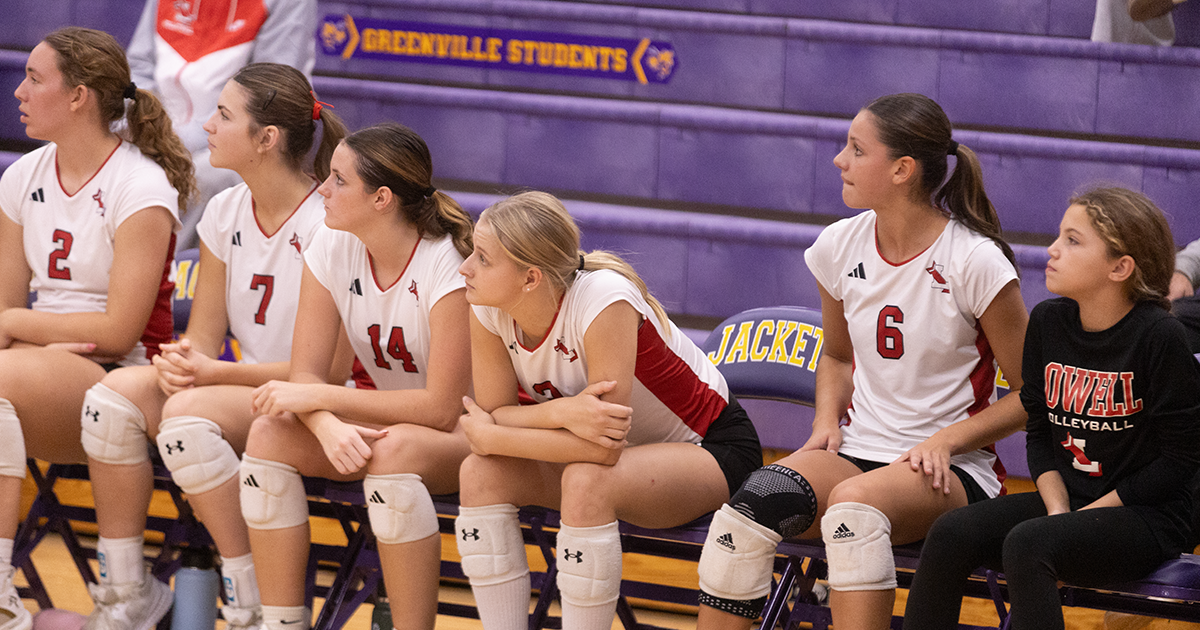
Volleyball makes the strongest case. There are 32 districts in Division 1, yet some districts repeatedly contain several of the state’s best teams. Lowell’s history with Rockford shows what that can mean.
The brackets from 2013 through 2026 show how often this matchup comes around. Lowell and Rockford shared a volleyball district in nine of those 14 seasons: every year from 2013 through 2019, then again in 2025 and 2026. They actually played six times in those districts, with Lowell going 1–5. Sharing a district and playing each other are different things, but both help explain why this feels so familiar.
Some of those matches put highly ranked teams on opposite sides of the net long before a regional trophy was at stake.
In 2017, top-ranked Rockford swept honorable-mention Lowell in the district opener.
In 2018, Lowell was No. 4 and Rockford No. 7 in the MHSAA’s district-week roundup. Rockford won the district final in five sets. The higher-ranked Red Arrows were done, and Rockford eventually finished as state runner-up. Two top-seven teams were playing for one district trophy.
In 2022, Forest Hills Central was No. 4 in the final MIVCA regular-season poll. The Rangers swept Lowell in the district semifinal.
In 2025, No. 1 Rockford swept No. 8 Lowell in the district final. One of the state’s top eight teams was guaranteed to go home that week. Those were statewide rankings, not district seeds.
With 32 district trophies available, I think the MHSAA should make a stronger effort to keep top teams from being concentrated in the same opening-round field.
There have been years when Lowell got through. In 2019, the Red Arrows swept Rockford in the district semifinal. Their regional then contained four of the top eight teams in the final MIVCA regular-season rankings: No. 2 Lowell, No. 4 Hudsonville, No. 5 Byron Center and No. 8 Grand Haven. Lowell beat Byron Center 3–0 and Hudsonville 3–1 to win it. Grand Haven was in the field, but was not a Lowell opponent.
Lowell was the highest-ranked team in that regional and deserves credit for winning it. The strength of the field still matters. Four top-eight teams were competing for one regional championship. The Red Arrows also swept Rockford in the 2020 regional final, another reminder that a larger school is beatable.
This year’s MHSAA district preview listed Forest Hills Northern at No. 7 and Lowell at No. 9 in Division 1. They were the district’s top two seeds. Lowell never reached Northern, losing 3–1 to Rockford in the semifinal. That result is a useful reminder that rankings do not decide matches.
Rockford earned that win. The larger question is how much the tournament should do, before the first serve, to account for enrollment gaps and the concentration of strong programs.
Football
Football offers a different version of the same frustration and the 2025 playoff draw has dampened what has been some horrific draws.
2021: Muskegon, 35–7. District semifinal, first round. Muskegon was No. 4 in Division 3.
2022: Zeeland West, 36–28. District semifinal, first round. Zeeland West was No. 7 in Division 3.
2023: Forest Hills Central, 35–20. District semifinal, first round. FHC was No. 2 in Division 3 and went on to win the state championship.
2024: DeWitt, 49–35. District final, second round. DeWitt was No. 1 in Division 3.
2025: Had an easy district draw with Coldwater and Middleville TK, I relent.
2026: DeWitt, 50–14. District semifinal, first round. DeWitt was No. 5 in Division 3.
So 5 of the last six years, Lowell drew at top seven team in the state in the first or second round. Now in football, there are 8 districts. So I contend, it’s more acceptable for top teams to face eachother.
This fall, Lowell drew defending Division 3 champion DeWitt in the district opener and lost 50–14. I contend that as a top ten team in the state (you can argue it but I fully believe we were in D3) that is a harsh opener, especially to travel that far.
Girls Basketball
The enrollment question is clearest in girls basketball. From 2013 through 2026, Lowell and Rockford were assigned to the same girls district in 10 of 14 tournament years: 2013–2018 and 2020–2023. That counts shared fields, not head-to-head games, and includes the canceled 2020 tournament.
The 2023 district final is the example that sticks with me. Lowell beat Cedar Springs and Forest Hills Northern before losing 71–35 to Rockford in the district final. Rockford entered the tournament No. 2 in the final Associated Press regular-season poll and went on to win the Division 1 championship. Lowell had finished the regular season 16–6 and entered that final 18–6. That put an 18-win Lowell team against the state’s No. 2 team, from a school with more than twice as many students.
The enrollment comparison that season was striking. The MHSAA’s 2022–23 list put Lowell at 1,106 students and Rockford at 2,469, more than twice as many. Every other school in that district was between 1,075 and 1,141. Rockford was the clear enrollment outlier in that particular group.
Enrollment does not guarantee a win, and Rockford’s players and coaches deserve credit for building a championship team. But this is exactly why divisions exist. If a division still places schools with such different enrollment in the same field, the size of that division deserves a closer look.
Boys Soccer
Boys soccer shows why enrollment alone cannot solve the problem. Here, the concern is how often highly ranked Division 2 teams land in the same district.
From 2013 through 2026, available coaches’ polls show that at least 11 of Lowell’s 14 districts included another top-10 Division 2 team. The poll archive is incomplete, and not every recovered poll is the final release before districts. Even with that limitation, the pattern is striking: from 2014 through 2018, a team ranked in the top six near the start of district play ended Lowell’s season.
In 2014, Lowell drew No. 4 East Lansing in the first round. East Lansing won that game 5–0 and went on to win the state championship. The next four seasons, Forest Hills Northern ended Lowell’s tournament run. The Huskies were ranked No. 2 in 2015, No. 6 in the Oct. 17, 2016 poll, No. 2 in 2017 and No. 1 in 2018. Lowell lost three straight district finals to Northern by scores of 1–0, 2–1 and 3–2 before drawing the top-ranked Huskies in the opening round in 2018.
It hasn’t stopped there. In 2022, Lowell’s district included No. 5 Forest Hills Central and No. 7 East Grand Rapids. In 2023, it had No. 3 Forest Hills Central and No. 7 Grand Rapids Christian, the eventual state champion. In 2025, No. 1 Forest Hills Central was in the district. This fall, it was No. 2 Grand Rapids Christian.
Not every one of those teams knocked Lowell out directly. Sharing a district is different from playing each other, and the available records do not establish a top-10 opponent in every season. But year after year, Lowell’s path has run through some of Division 2’s best teams. There are 16 districts in the division, and Lowell hasn’t won one since 2003. Having watched these teams, I believe that drought says less about the quality of the program than the trophy count suggests.
The Standard Has to Work Both Ways
Any honest version of this discussion has to include wrestling. Lowell won 13 straight Division 2 team championships from 2014 through 2026. In that sport, Lowell is the powerhouse other schools have to get through.
The 2009 Lowell–Greenville matchup made that point from the other side. Lowell won 33–25 in the regional final and went on to win the state title. I was 13, I remember the night well. After the match, Coach Dave Dean objected to the teams meeting at regionals and said the matchup belonged in Battle Creek, the site of the state finals. Greenville did deserve to be there. Just as John Glenn has the past two years, but have been pitted with neighbor and fellow top ten team Freeland.
That success belongs in the argument, too. A consistent program can become the difficult draw without having Rockford’s enrollment. If we want a better system, the standard has to apply when Lowell benefits as well as when Lowell is the team going home early.
What Should Change
The MHSAA’s explanation for most district and regional groupings is geography, with program strength not considered when those groups are formed. Keeping school-night travel manageable is a legitimate concern. It also helps explain why neighboring strong programs keep meeting so early.
Volleyball already has seeding. The 2026 tournament rules use Michigan Power Rating to separate the top two teams within each district. That helps with the order of the games, but it does not change which schools are assigned to the district. This year, Northern and Lowell were separated in the bracket and Lowell still lost before the final.
Football offers an example of a broader approach. In 2026, the MHSAA began seeding within eight-team regions using playoff-point averages, then assigning those seeds to two districts. That is different from using opinion polls, and it shows that geography and a broader seeding system can coexist.
I’d like the MHSAA to take three steps:
Review the enrollment spread within each division. My preference is eight divisions in sports with enough participating schools to support them. Eleven-player football already has eight. The MHSAA should test what narrower enrollment ranges would mean for other sports, rather than assume the current number of divisions is the right one.
Test seeding across a broader geographic area. Compare the current districts with a model that seeds teams within a larger region before assigning them to districts. Use a consistent, published rating system, with room to evaluate its limitations. Polls help illustrate the problem; they do not have to become the seeding formula.
Publish the tradeoffs. Show schools the projected travel, enrollment ranges and competitive balance under each option. Set reasonable travel limits, then see where a modest adjustment could prevent an unusually crowded district. Transportation costs matter, but they should be weighed alongside the quality of the tournament.
No format can guarantee that every good team advances, and a ranking is never a right to a trophy. These records also cannot tell us how Lowell would have fared in a different bracket. What they can do is identify places where the structure deserves another look.
Lowell has beaten larger schools and highly ranked teams, and it has built a wrestling program that makes other schools’ paths harder. All of that belongs in the discussion. A fair standard has to apply across the state, including when it makes Lowell’s road more difficult.
The goal should be a tournament that rewards a strong season while giving schools of reasonably comparable size a fair chance to compete. The teams still have to settle it on the court or field. The MHSAA can do more to make sure the bracket gives them a fair starting point.